
Independent information
PackQR has no commercial relationship with PODS, Apple or any other company mentioned in this guide. PODS is included as one example of the portable moving-container model. Mentioning a company, product, service or published price is not a recommendation, partnership or endorsement.
At a glance
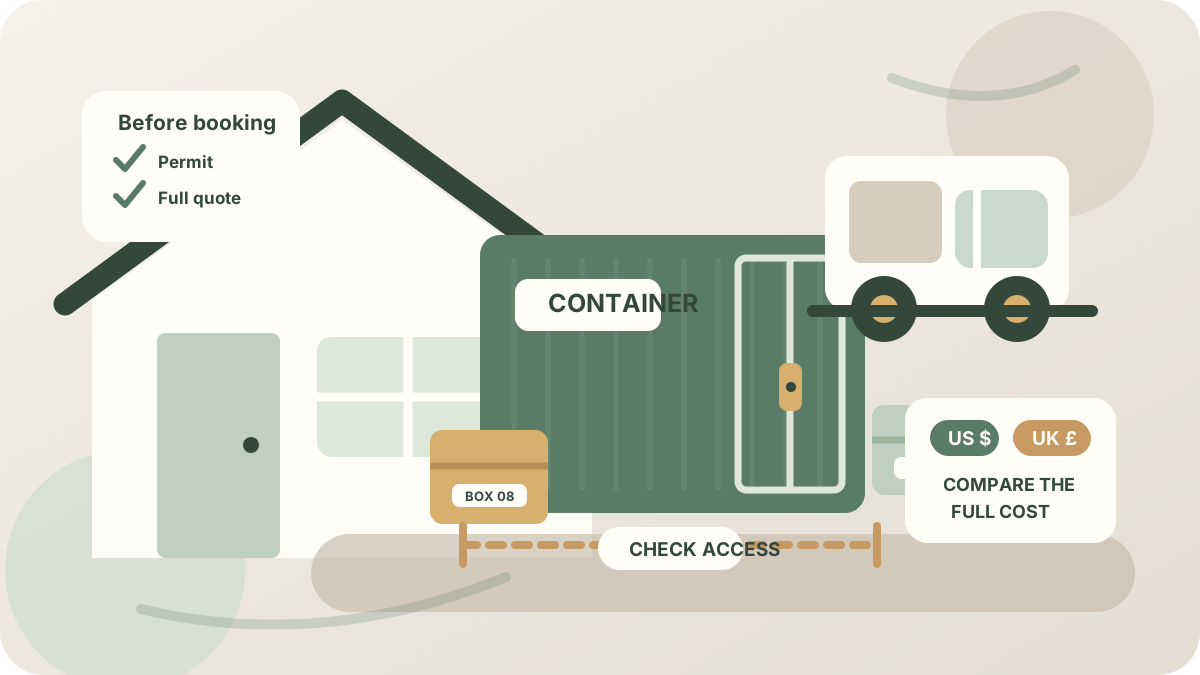
A container is delivered to your property, loaded by you and then collected for transport or storage. Before booking, confirm availability at both addresses, check that the delivery vehicle has enough space, obtain permission for the container’s placement and compare the complete cost rather than the advertised rental rate alone.
Portable moving containers
A moving container separates packing from driving.
A traditional self-move often compresses everything into a short period.
You collect a rental vehicle, load it, drive to the new property, unload it and return it before the hire period ends. Delays with keys, traffic or helpers can quickly turn that timetable into a stressful one.
A portable moving container changes the order of events.
The provider delivers an empty container to your home. You load it over an agreed period, secure it and arrange collection. The company then transports it to the new address or places it in storage until you are ready.
PODS is one provider using this model. Its current US information lists 8-foot, 12-foot and 16-foot weather-resistant containers, although the sizes available depend on the location and type of move. The 12-foot option is generally limited to local moves and storage.
1. Understand what the service includes.
A portable moving-container service usually combines three separate elements:
- Delivery of an empty container.
- Rental while it is being loaded, stored or unloaded.
- Transport between properties or storage facilities.
You normally pack and load the belongings yourself unless additional labour has been arranged separately.
Once the container is ready, the provider collects it and either moves it directly to the destination or stores it at one of its facilities. It is then delivered for unloading before the empty container is removed.
This flexibility can be useful when completion dates do not align, renovation work is unfinished or the new property is not immediately ready.
However, it is not the same as employing a full-service removal company. You remain responsible for packing, lifting, arranging the load and protecting the contents from movement.
2. Confirm availability at both addresses.
Do not assume that national or international advertising means every address is covered.
Portable-container services depend on local depots, transport routes, vehicle access and regional restrictions. A provider may serve your current postcode or ZIP code but not the destination.
PODS currently describes services in the United States, Canada and the United Kingdom, with some company information also referring to Australia. Availability and the exact service model should still be confirmed through an address-specific quotation.
In the UK, similar services may be described as mobile self-storage, door-to-door storage, delivered storage containers, portable storage or containerised removals.
The operating model can differ. Some companies leave a container at the property, while others load storage modules onto a vehicle or take belongings directly to a warehouse.
Ask exactly where the container will be kept, whether you can access it during storage and whether the same container will travel to the destination.
3. Check whether the container can be delivered safely.
The container itself may fit into a parking space, but the delivery vehicle usually needs considerably more room to manoeuvre.
Before booking, measure the intended position and consider:
- The width and length of the driveway.
- The road width and turning space.
- Parked vehicles.
- Low branches and overhead cables.
- Gates, walls and roof overhangs.
- Slopes and uneven ground.
- Drain covers, soft surfaces and underground services.
- Access for neighbours and emergency vehicles.
The driver may refuse delivery if the site cannot be used safely. Send the provider photographs and accurate measurements before the delivery date rather than relying on a description such as “standard driveway”.
Ask how the container will be positioned and which direction its door will face. A container placed too close to a wall or fence may be impossible to open.
4. Obtain permission before arranging delivery.
You may need permission even when the container will sit close to your home.
In the US, this could involve a city permit, parking restriction, apartment manager or homeowners’ association.
In the UK, contact the local council if any part of the container or delivery operation will use the public highway. Also check:
- Parking suspension requirements.
- Controlled parking-zone rules.
- Restrictions in the property lease.
- Landlord or managing-agent approval.
- Estate or private-road covenants.
- Limits on how long a container may remain outside.
Permission should cover delivery, the full rental period and collection. A permit for one day may not be sufficient if the container will remain in place for several weeks.
5. Compare the complete price.
Portable-container pricing is rarely a single fee.
A quotation may include separate charges for:
- Initial delivery.
- Monthly or weekly container rental.
- Collection from the first property.
- Transport mileage.
- Storage at the provider’s depot.
- Redelivery at the destination.
- Final collection.
- Insurance or contents protection.
- Locks and packing materials.
- Waiting time, failed attendance or date changes.
- Fuel, congestion, toll or ferry charges.
Ask for the full anticipated cost from the first delivery until the empty container is removed.
Also ask what happens if the move takes longer than expected. Moving into another billing period can add a full month or several additional weeks of rental.
6. Use US prices only as a planning guide.
PODS does not publish one fixed national rate. Quotations depend on the pickup and delivery locations, distance, time required, container size, number of containers, availability and season.
A PODS moving-cost guide updated in July 2026 gives a broad US planning range of a few hundred dollars to more than $1,000 for a local move. It places the average long-distance move at roughly $2,500–$5,000.
These are broad moving-cost guides rather than guaranteed PODS quotations. A large household, cross-country route, extra storage month or peak-season date can produce a much higher total.
Always obtain a written, move-specific quotation and confirm which charges are included.
7. UK prices follow a different model.
Direct UK comparisons are difficult because many providers offer static container hire or mobile self-storage rather than the same long-distance service commonly marketed in the US.
Published UK examples checked in July 2026 included:
- £18 per week including VAT for an 8-foot storage container.
- £19.20 per week including VAT for a 10-foot container.
- £20.40 per week including VAT for a 12-foot container.
Those examples are container-rental prices from one UK supplier. They are not quotations for moving a household between two properties, and minimum hire periods may apply.
Delivery, collection and haulage can cost more than the container rental itself, particularly where a crane-equipped vehicle is required or the addresses are far from the provider’s depot.
For a meaningful UK comparison, ask each provider to price the same complete scenario:
- Container delivery to the current home.
- A defined loading period.
- Transport to the destination or storage depot.
- A defined storage period.
- Redelivery to the new home.
- Time allowed for unloading.
- Final collection.
- VAT and any access surcharges.
Prices vary considerably by region. London, restricted urban streets, islands and remote locations may attract higher transport or access charges.
8. Book the service dates early.
Portable containers reduce the pressure to pack in one day, but delivery and collection still depend on vehicle schedules.
Book early during summer, school holidays and the end of the month. Some providers recommend at least ten days’ notice for preferred scheduling, with more time needed in busy markets.
Ask when the delivery window will be confirmed and how precise it is likely to be.
Keep the placement area clear for the full window. A driver may be unable to wait while parked cars are moved, gates are unlocked or permission is obtained.
Before each appointment, verify:
- The property address.
- Your telephone number.
- The container number.
- The intended placement.
- The collection date.
- The destination address.
- Any gate codes or access instructions.
9. Pack for transport, not just storage.
A container may remain level while it is outside your home, but its contents will still experience movement during lifting and road transport.
Use strong boxes and fill empty spaces so items cannot shift. Distribute weight across the floor rather than concentrating heavy furniture in one corner. Place heavier boxes at the bottom and lighter belongings above them.
Secure sections of the load progressively. Do not wait until the container is full before trying to restrain everything near the door.
Protect against:
- Side-to-side movement.
- Items falling forward when the door opens.
- Furniture rubbing together.
- Moisture entering through open doors during loading.
- Condensation caused by temperature changes.
- Excess weight in one area.
Weather-resistant does not mean immune to every moisture risk. Raise vulnerable contents from the floor where appropriate and keep prohibited, hazardous and irreplaceable items out of the container.
10. Use your own lock and record the load.
Confirm whether the provider supplies a lock or requires you to provide one. Check the required shackle size or lock type before delivery.
Before closing the container:
- Photograph each completed section.
- Record valuable items and serial numbers.
- Photograph the final load.
- Note the container identification number.
- Check that the door closes without pressure from the contents.
- Confirm that the lock has engaged properly.
Do not write a detailed list of valuables on the outside.
Use visible labels for handling information, the destination and a box reference. Keep the full inventory private.
With PackQR, individual boxes can be recorded before loading, making it easier to locate essential items when the container arrives without displaying sensitive contents on the packaging.
11. Treat an AirTag as a secondary check.
A personal tracking device may provide reassurance during storage or transport, but it is not a live professional tracking system.
An AirTag’s location is updated when it connects to Apple’s Find My network. A container in a remote depot or on an isolated route may therefore show an old location for an extended period, and walls or other objects can affect performance.
Unknown-tracker alerts are supported on current Apple and Android systems. A tracker travelling for an extended period near drivers or storage staff could therefore generate a safety notification.
Before including one:
- Check the provider’s terms.
- Keep it inside an item that belongs to you.
- Do not attach it to or interfere with the provider’s container.
- Do not place it where it could obstruct equipment.
- Make sure its use is lawful.
- Accept that updates may be delayed or incomplete.
A personal tracker should supplement the provider’s records, not replace them.
12. Know when a container is the wrong option.
A portable container can work well when:
- You want several days or weeks to pack.
- The properties have suitable access.
- Your dates do not align.
- You need temporary storage between homes.
- You are comfortable loading your own belongings.
- You can secure the required permission.
It may be less suitable when:
- Neither property has safe placement space.
- Street permits are difficult or expensive.
- You need regular access to stored belongings.
- The household contains many fragile or specialist items.
- You cannot safely lift or secure the load.
- The destination is outside the provider’s network.
- A full-service removal quote is similar in price.
Compare the container option with a rental van, conventional self-storage and a professional removal company.
The most flexible-looking service is not automatically the cheapest or simplest once every charge is included.
Flexibility still needs planning.
Portable moving containers can remove the pressure of completing an entire move within one vehicle-hire period.
They allow packing, transport and storage to be managed as separate stages. That can be particularly useful during a delayed completion, renovation or long-distance move.
But the convenience depends on suitable access, clear permission, careful loading and a complete understanding of the price.
Confirm the service area. Measure the site. Compare written quotations on the same basis. Check the terms, insurance and cancellation rules before paying a deposit.
The container creates more time. Good planning determines whether that time makes the move easier.
Price and service sources.
The examples in this article were checked on 15 July 2026. They are included for general comparison and may change without notice.
- PODS portable-container sizes.
- PODS guide to moving costs.
- PODS delivery requirements and permits.
- Portable Space UK container-hire prices.
- Apple guidance on unknown tracking alerts.
General information: This is independent practical information, not an endorsement of PODS, Apple or another provider. Prices, service areas, permits and terms can change. Obtain current written quotations and confirm local legal, access and insurance requirements before booking.