
Pack together. Share less. Stay private.
PackQR 1.9 adds read-only Siri, Shortcuts and Spotlight discovery plus adaptive Duo layouts.
Find eligible ordinary inventory from Apple system surfaces, keep Sensitive Boxes outside those results, and move between compact and expanded Duo layouts without resetting the live packing experience. The local-first storage and collaboration model remain unchanged.
30 September 2026
PackQR 1.9: Siri, Shortcuts, Spotlight and Duo layout support
Version 1.9 adds read-only App Intents for finding eligible ordinary items and boxes, getting room or box contents, and opening returned results in PackQR. Those actions are available to Apple Shortcuts and supported Siri experiences without giving system integrations permission to create, edit, move or delete inventory.
Core Spotlight can now surface eligible ordinary items and boxes and deep-open the matching PackQR context. Sensitive Boxes are excluded from Siri, Shortcuts and Spotlight, and enabling App Lock suppresses PackQR inventory from Spotlight while the lock remains enabled.
The same release adds adaptive Duo layout support. PackQR can move between compact and expanded widths while keeping the live navigation hierarchy and scroll position stable, so a packing list does not reset simply because the available width changes.


30 September 2026
Move Planner 1.3 released on the App Store
Move Planner 1.3 (Build 69) is now available free on the App Store for iPhone and iPad. The release adds adaptive and resizable iPhone layouts while preserving the same planning hierarchy, search state and Daily Briefing presentation across compact and regular widths.
The update does not expand the optional PackQR data contract or change the app’s local-first privacy model.
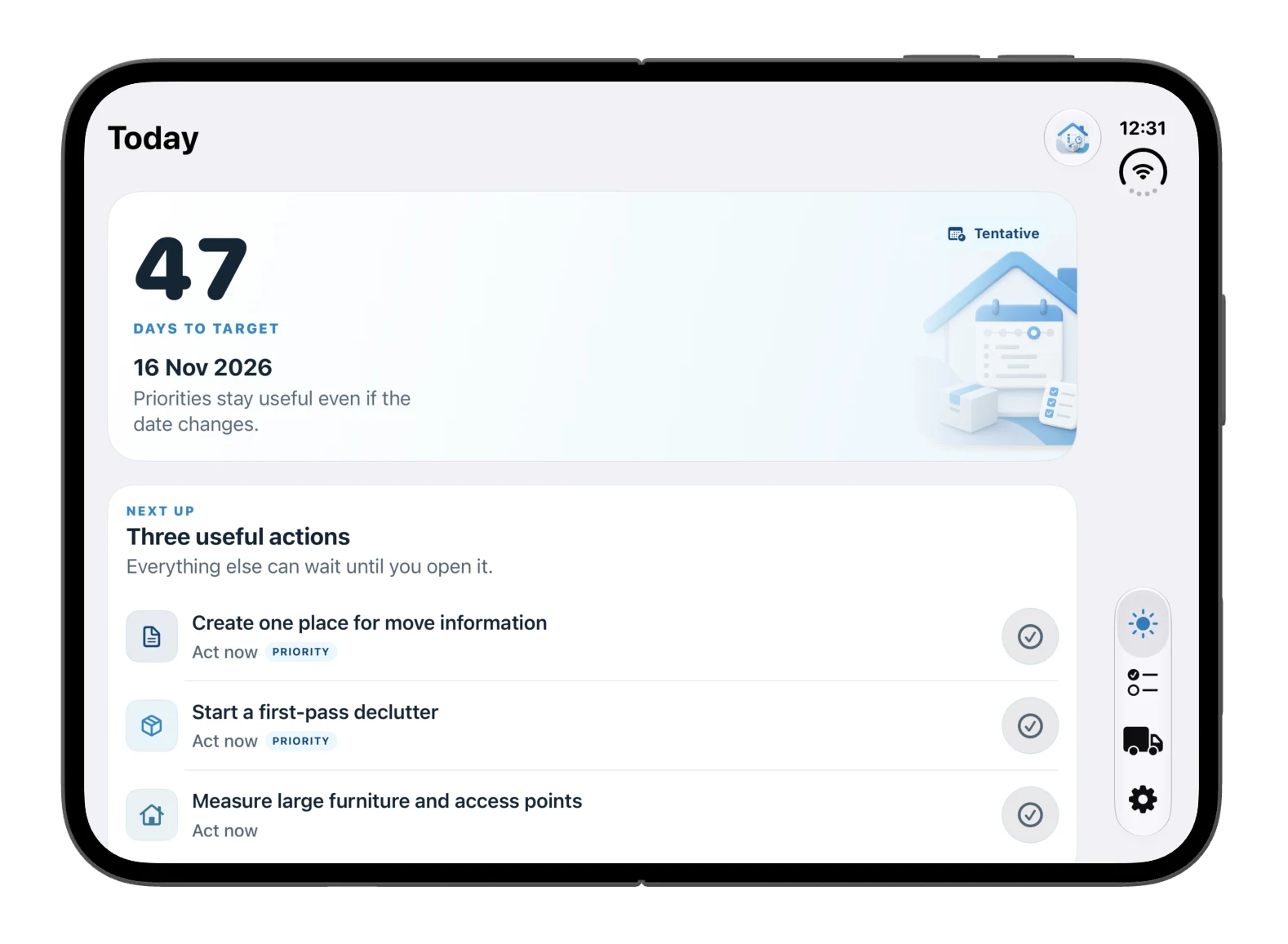

The previews illustrate the adaptive width behaviour shipped in version 1.3 rather than making a claim about any particular hardware model.
22 August 2026
PackQR 1.8: private two-device packing, protected boxes and safer local continuity
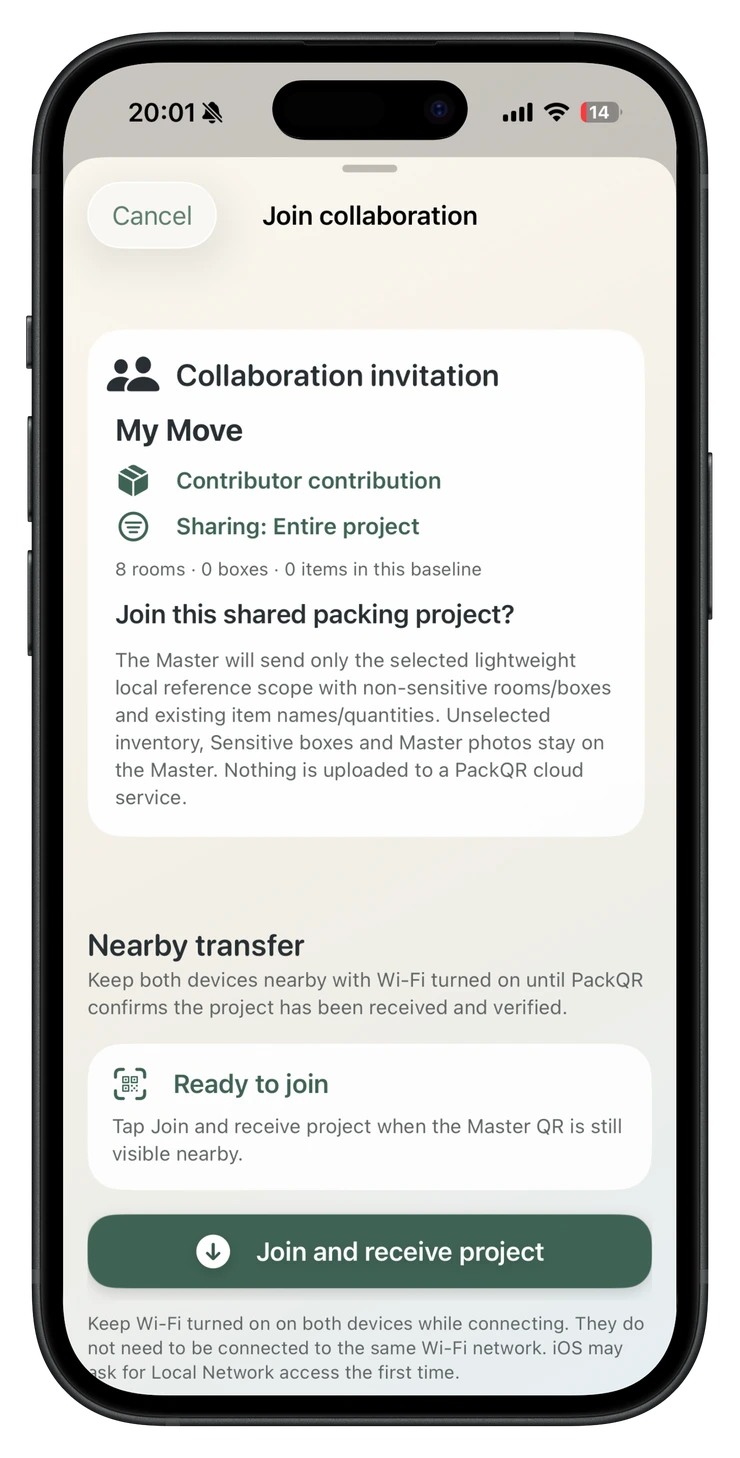
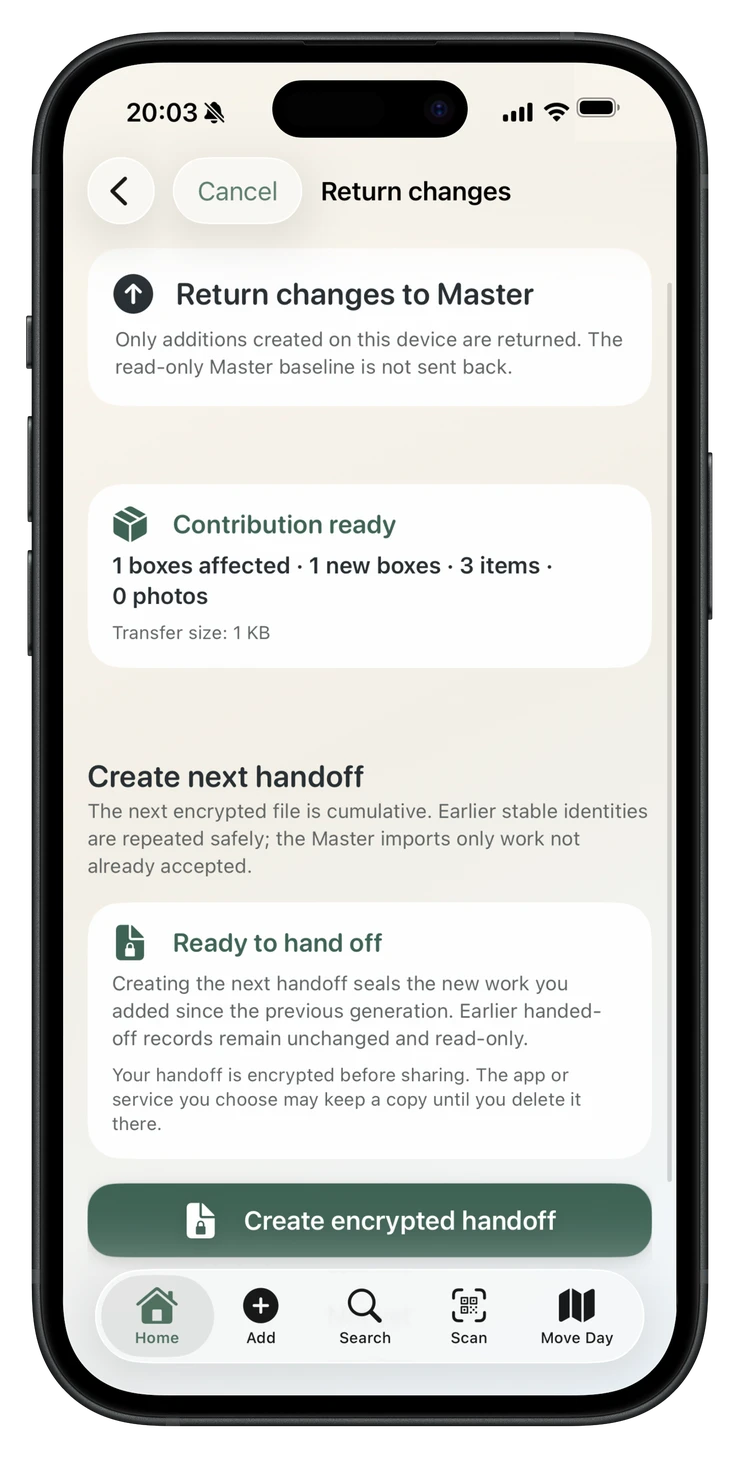
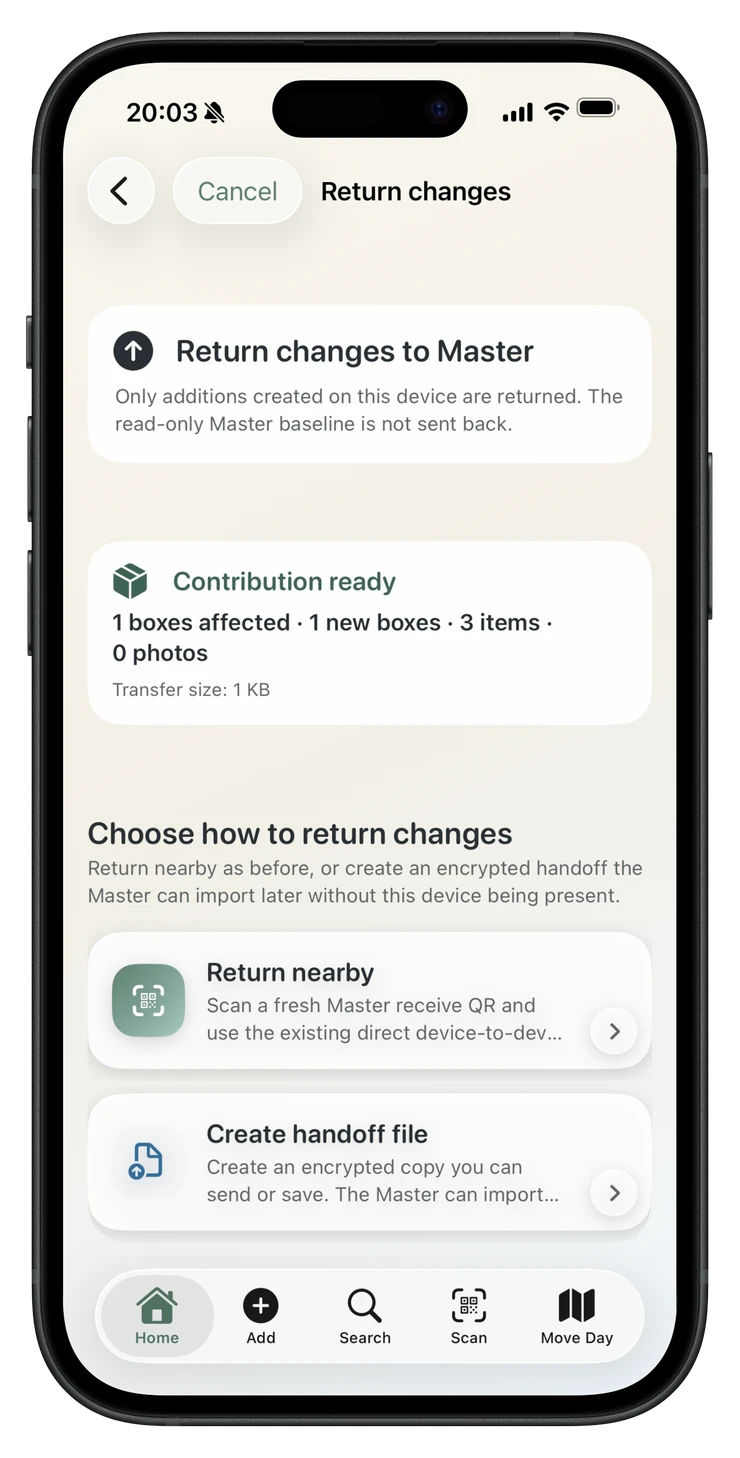
Version 1.8 brings PackQR’s current moving workflow together in one release. A Master iPhone or iPad pairs directly with one nearby Contributor by QR code and can share the Entire project, Selected rooms or Selected boxes. After that initial handoff, the Contributor works independently, can be offline or in another location, and can return additive changes either directly when nearby or as an encrypted PackQR handoff file shared remotely—for example by email—for explicit Master review and import.
Sensitive Boxes protect private item names, notes, photos and estimated values behind Face ID, Touch ID or device passcode. Master Sensitive Boxes are excluded from collaboration sharing, and standard reports exclude protected contents by default.
Optional estimated replacement values remain outside normal quick packing. Users can add values later, review unvalued items efficiently, see quantity-based totals with honest valuation coverage, and optionally include values in PDF or CSV contents reports. PackQR does not guess prices or provide professional appraisal.
Version 1.8 also strengthens local-data safety. PackQR now records privacy-safe continuity metadata on-device and fails closed if it finds evidence of a previous inventory but the protected local store is unexpectedly missing. Instead of silently creating an empty replacement, it shows a recovery screen with a non-destructive Check again action and an explicit Start fresh choice. Release builds also dismiss the launch cover as soon as the real Home layout is ready, while engineering diagnostics remain out of normal production output.
Collaboration received performance hardening too: the nearby pairing QR path is prewarmed away from the main interface so invitation presentation remains responsive. Returned changes use PackQR’s dedicated encrypted handoff file type, allowing either a nearby direct return or remote return through a user-chosen iOS share method such as email, with a cleaner share/open flow on the Master.
PackQR 1.8 collaboration
21 August 2026
PackQR 1.7: estimated replacement values and simple contents reports
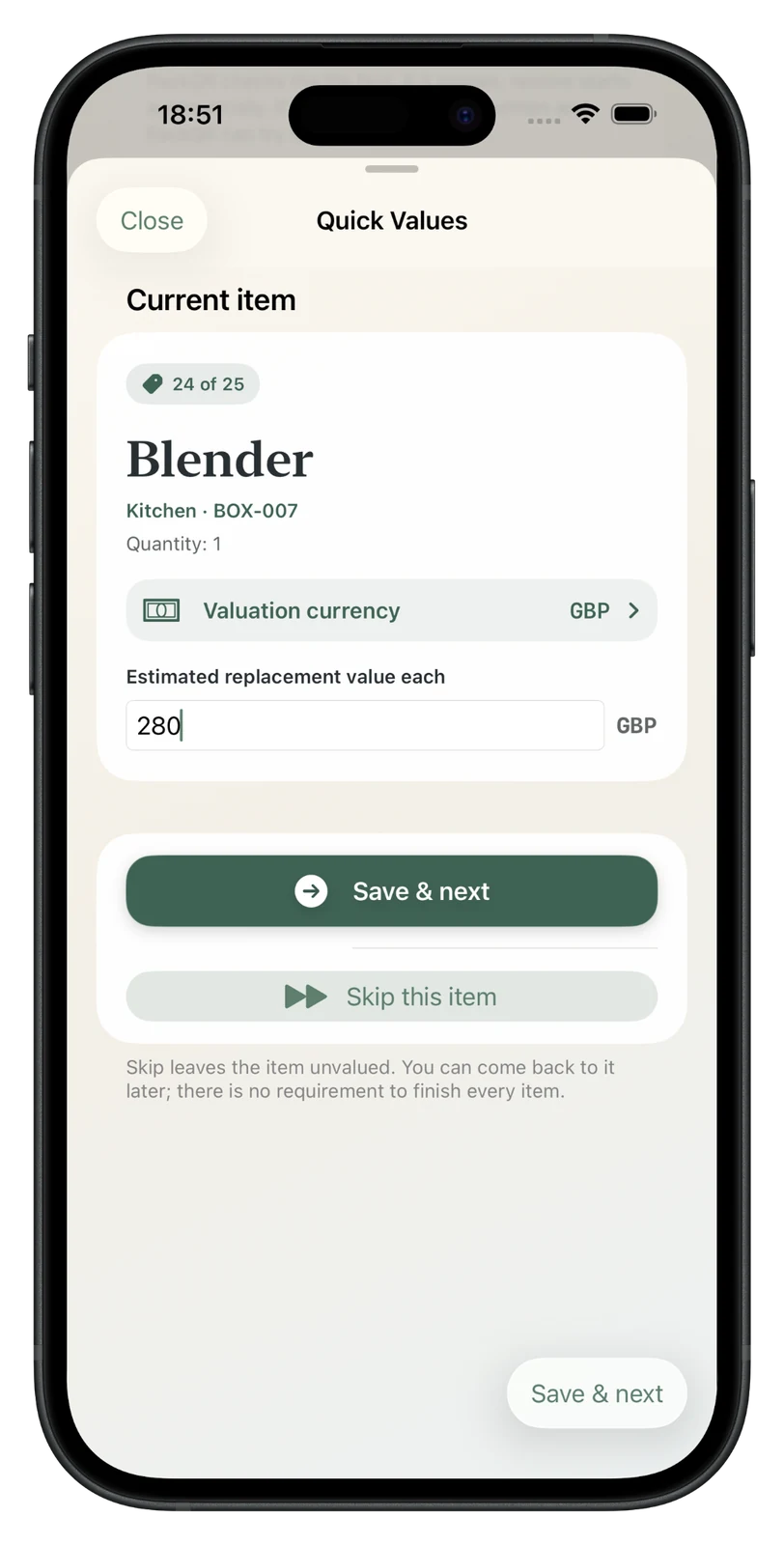
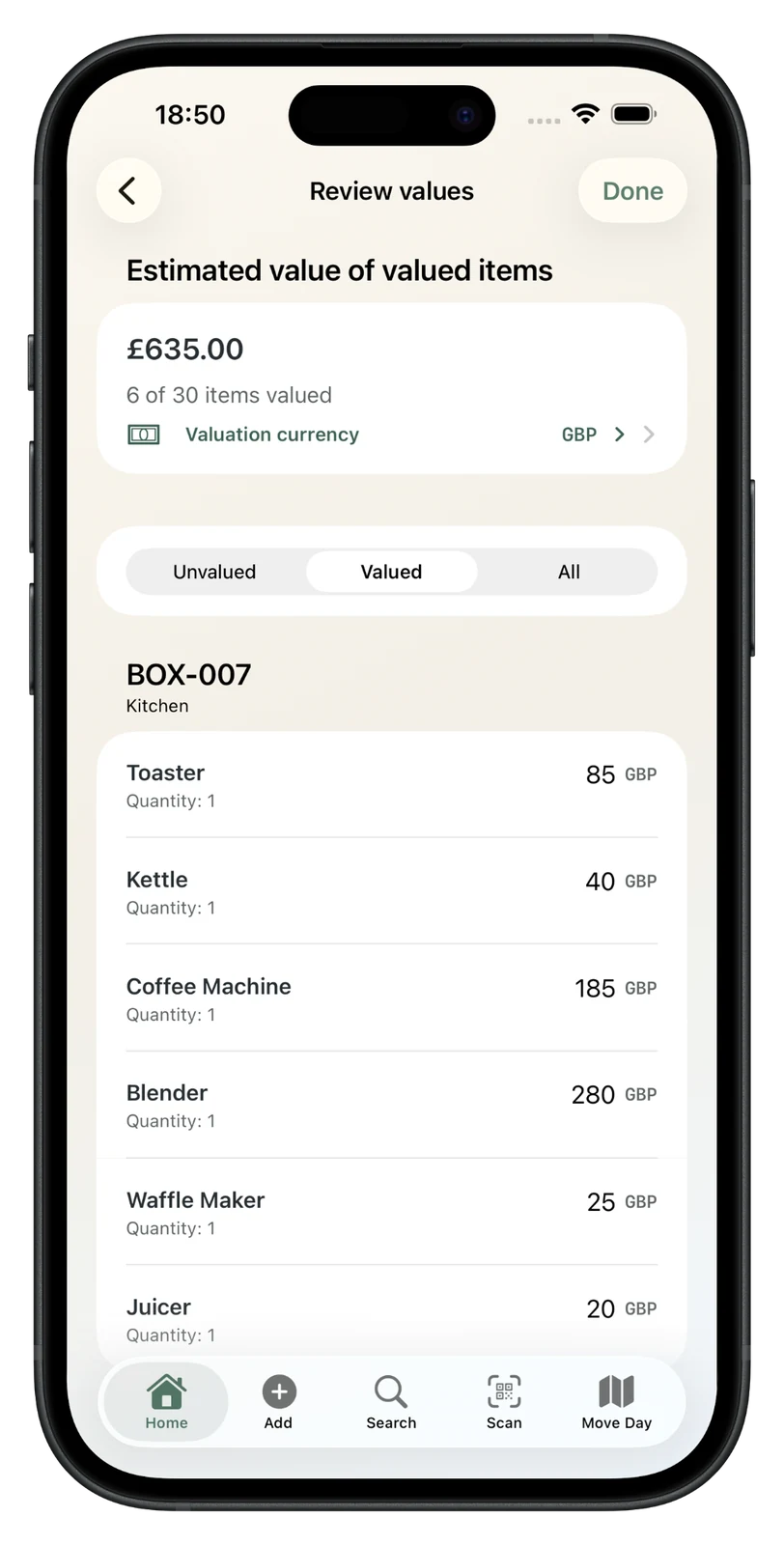
Version 1.7 adds one optional item-level field: Estimated replacement value. It remains out of the normal quick packing path. Users can add a value later from item details or work through a focused Review values screen with Unvalued, Valued and All filters.
PackQR stores the amount as estimated replacement value each, calculates quantity-derived line totals and keeps blank distinct from an intentional zero. Box and project rollups use only entered values and pair incomplete totals with coverage such as “6 of 30 items valued”, so a partial record is never presented as a complete household valuation.
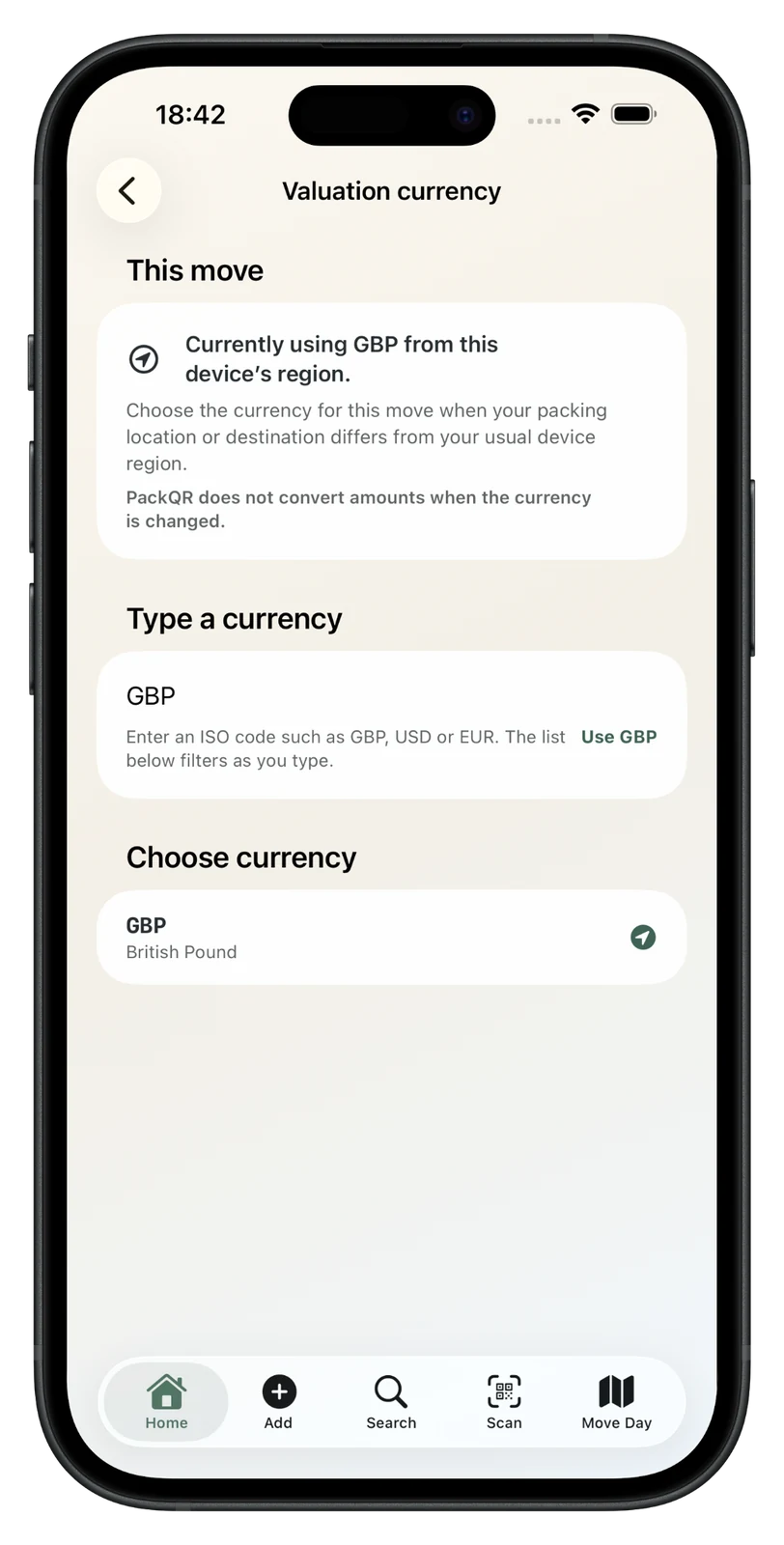
Each move uses one persisted valuation currency. A first value can initialise it from the device region, while later currency changes warn that existing amounts are not converted. Value-enabled PDF/CSV contents reports can include per-item values, line totals, box subtotals, project known value and coverage. AI Pack Scan and voice do not infer or silently save prices.
Privacy follows the existing Sensitive-box model: locked Sensitive values and subtotals are concealed, visible aggregate totals do not leak them, standard reports exclude Sensitive contents by default, backups preserve values and currency, and existing Master values remain out of Contributor collaboration baselines.
Pack first, value later
21 August 2026
Move Planner 1.2 released
Move Planner 1.2 is available free on the App Store. The release improves the optional private PackQR connection with clearer packing-summary status and a visible in-place summary check, without automatically switching apps.
It also carries forward dark-mode readability, iPad sharing and release-reliability improvements. Item names, photos, notes, QR contents, estimated replacement values, valuation totals and Sensitive-box contents remain outside the Move Planner summary.
20 August 2026
PackQR 1.6: Sensitive Boxes, scoped sharing and smoother repeat collaboration
Version 1.6 strengthens the privacy model on the device and reduces how much Master inventory needs to leave it. Boxes can now be marked Sensitive and revealed with Face ID, Touch ID or device passcode. A Home-screen Sensitive boxes switch can re-lock private boxes immediately while ordinary PackQR packing remains available—useful before handing the device to someone helping with the move.
Collaboration now offers Entire project, Selected rooms and Selected boxes before the join QR is created. The Contributor receives only the chosen lightweight Master context, and Master Sensitive boxes remain on the Master. After reviewed import, Continue packing together starts a completely fresh collaboration session from the updated Master state while carrying forward the previous disclosure scope where it remains valid.
The release also separates App Lock from Sensitive-box locking, prevents repeated authentication prompts, hardens continuation/leave navigation, improves Light and Dark Mode action-icon contrast, preserves Sensitive state through backup/restore, redacts Sensitive contents from standard CSV/PDF contents outputs, and seals production diagnostics so high-volume development tracing is not emitted in the normal App Store Release build.
19 August 2026
PackQR 1.5: QR-paired local collaboration for two people
Version 1.5 introduces a deliberate Master + Contributor collaboration model for households where two people want to pack the same move without creating a PackQR account or putting the detailed inventory into a PackQR cloud service.
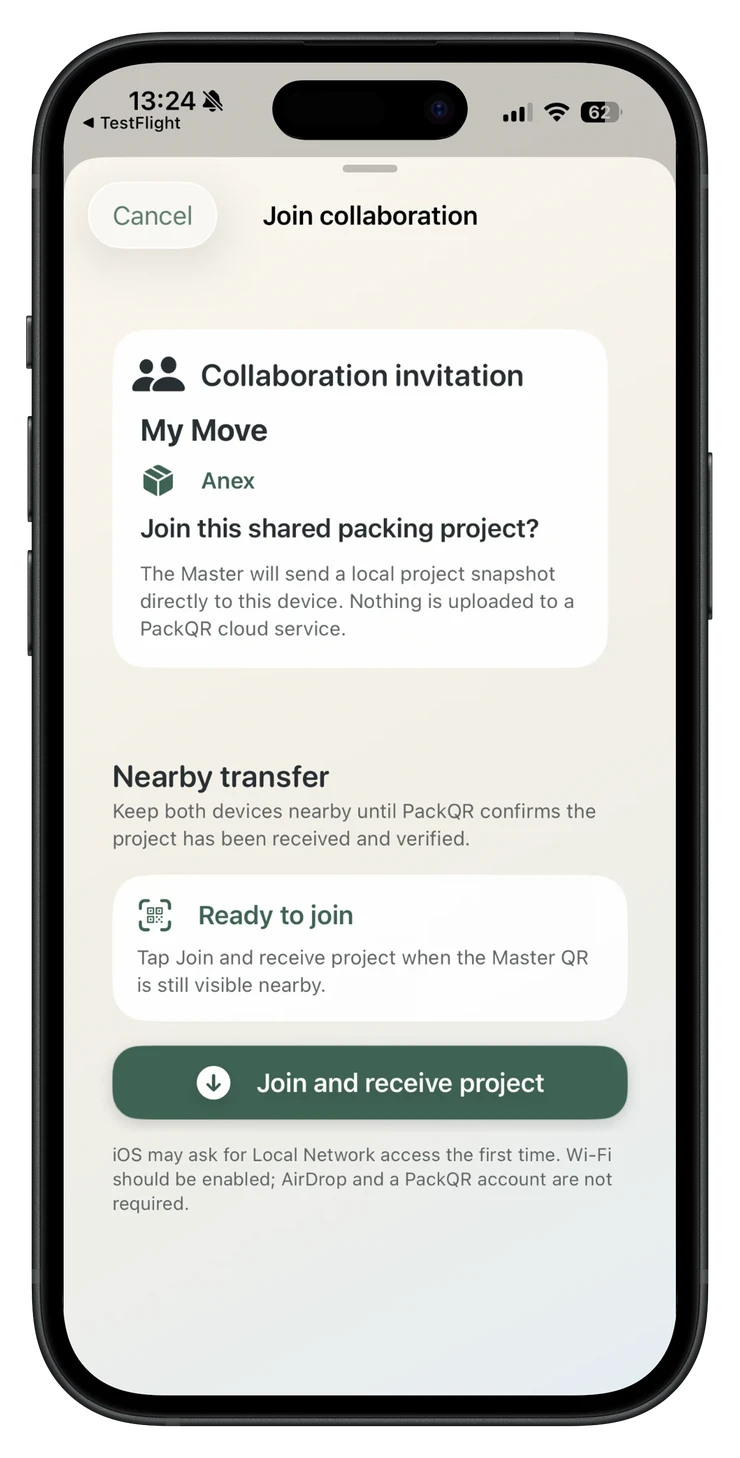
The Master shows a short-lived QR code and sends a lightweight active project baseline directly to the nearby Contributor device. Master-originated rooms, boxes and item names/quantities remain read-only reference context; Master photos and notes stay on the Master. After joining, the Contributor can work independently offline using normal keyboard entry, AI Pack Scan, supported voice input and Contributor-created photos.
In version 1.5, return was designed around both devices being together again: the Master showed a fresh receive QR and the Contributor explicitly returned the additive contribution, including Contributor photos. The Master reviewed destination groups and any structural issues before importing selected changes in one atomic commit. PackQR 1.8 keeps that nearby return option and also allows the encrypted return handoff file to be sent remotely after the initial nearby pairing.
The release also adds clearer Wi-Fi guidance and retry paths for nearby transfer, Data Health auditing and safety-gated cleanup tools, active-photo diagnostics, and stronger local upgrade protection so PackQR’s private inventory database and photo files share the same app-data lifecycle going forward.
Two devices, one deliberate handoff
15 August 2026
PackQR 1.4: multi-item voice input and one AI + voice Pack Batch
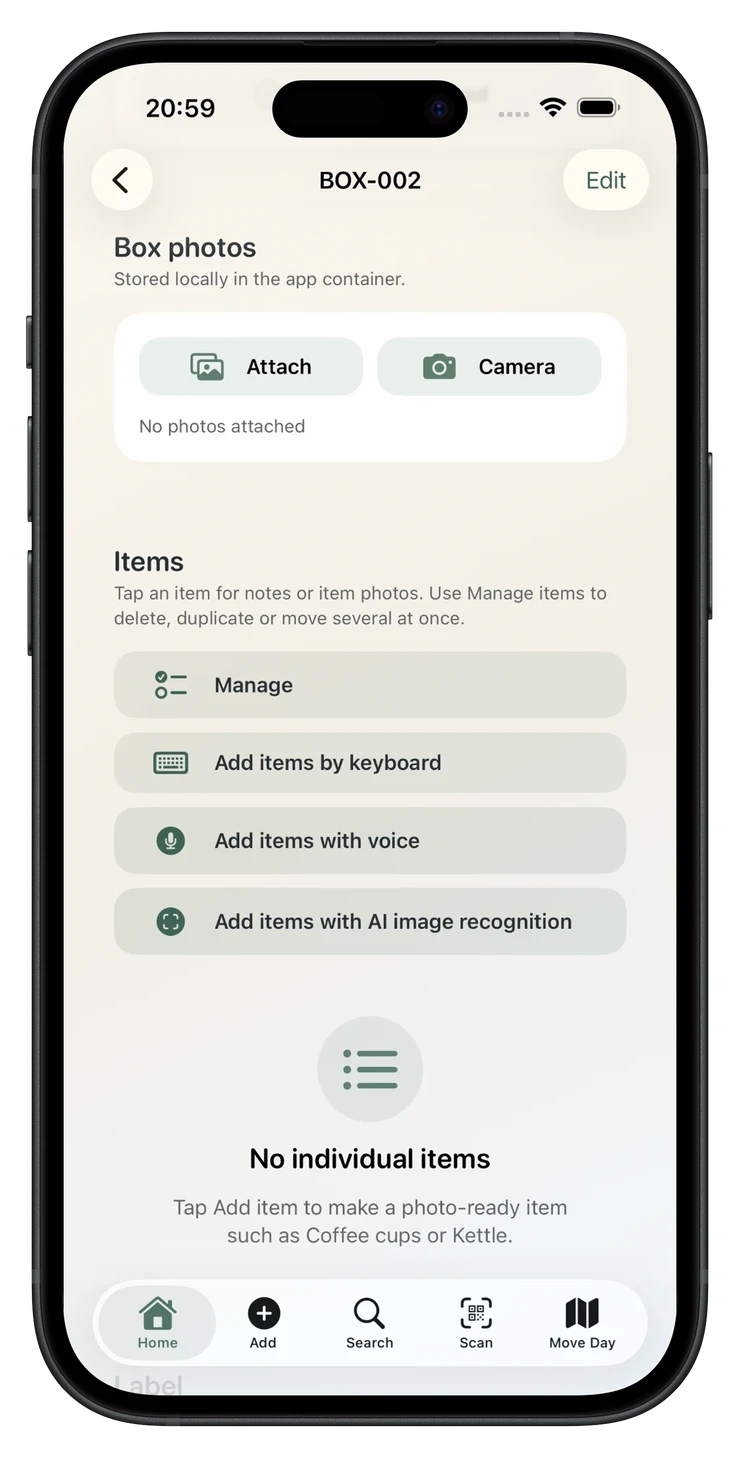
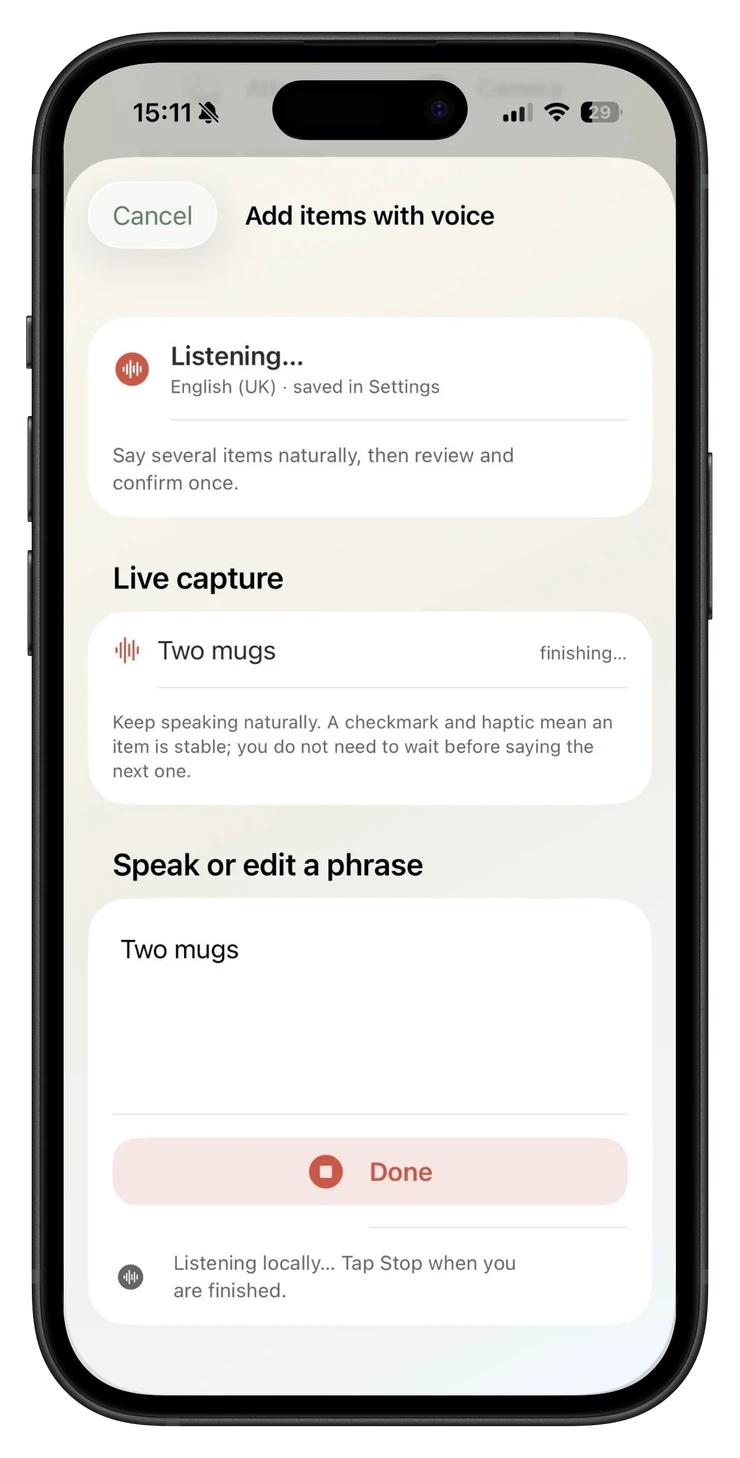
Version 1.4 makes item entry substantially faster. Users can now say several new box contents naturally—including quantities—rather than stopping to type each row. Voice input is addition-only, every proposed item remains editable, and nothing changes the saved inventory until the user confirms.
AI Pack Scan and voice now connect through one temporary Pack Batch. Reviewed AI suggestions can accumulate across several scans, the current AI suggestion can be corrected by voice, missing items can be added by voice, and the combined batch can be reviewed and confirmed once.
The production voice workflow is deliberately privacy-first: PackQR requires Apple on-device speech recognition, does not fall back to online recognition, does not retain an audio file, and exposes English (UK) and English (US) voice configurations in this release.
The release also includes camera-session reliability work, larger review controls, compiler restructuring for reliable Release archives, and a visual-integration pass so the new voice and Pack Batch screens use the same icons, card surfaces and Dark Mode language as the rest of PackQR.
Voice becomes a first-class way to pack
31 July 2026
PackQR 1.3: AI Pack Scan and optional local learning
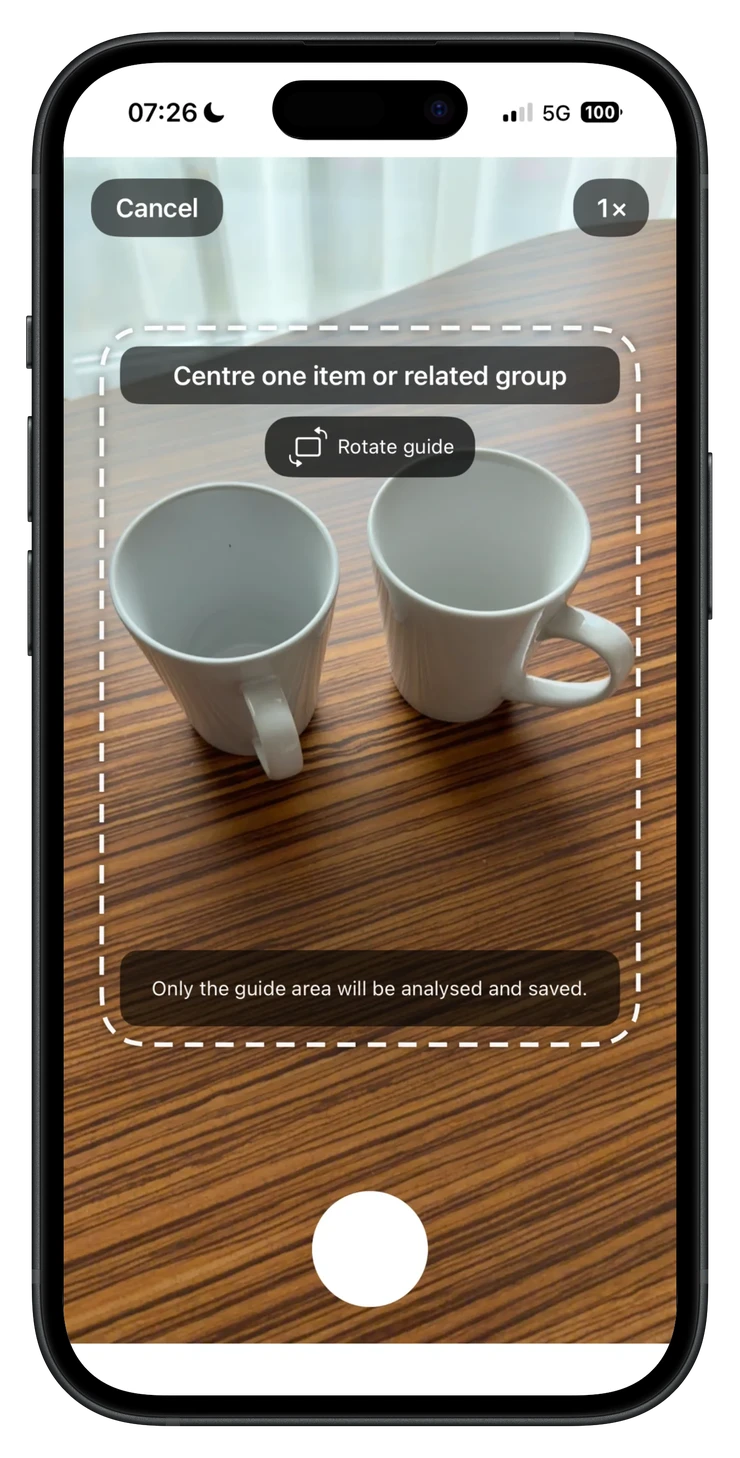
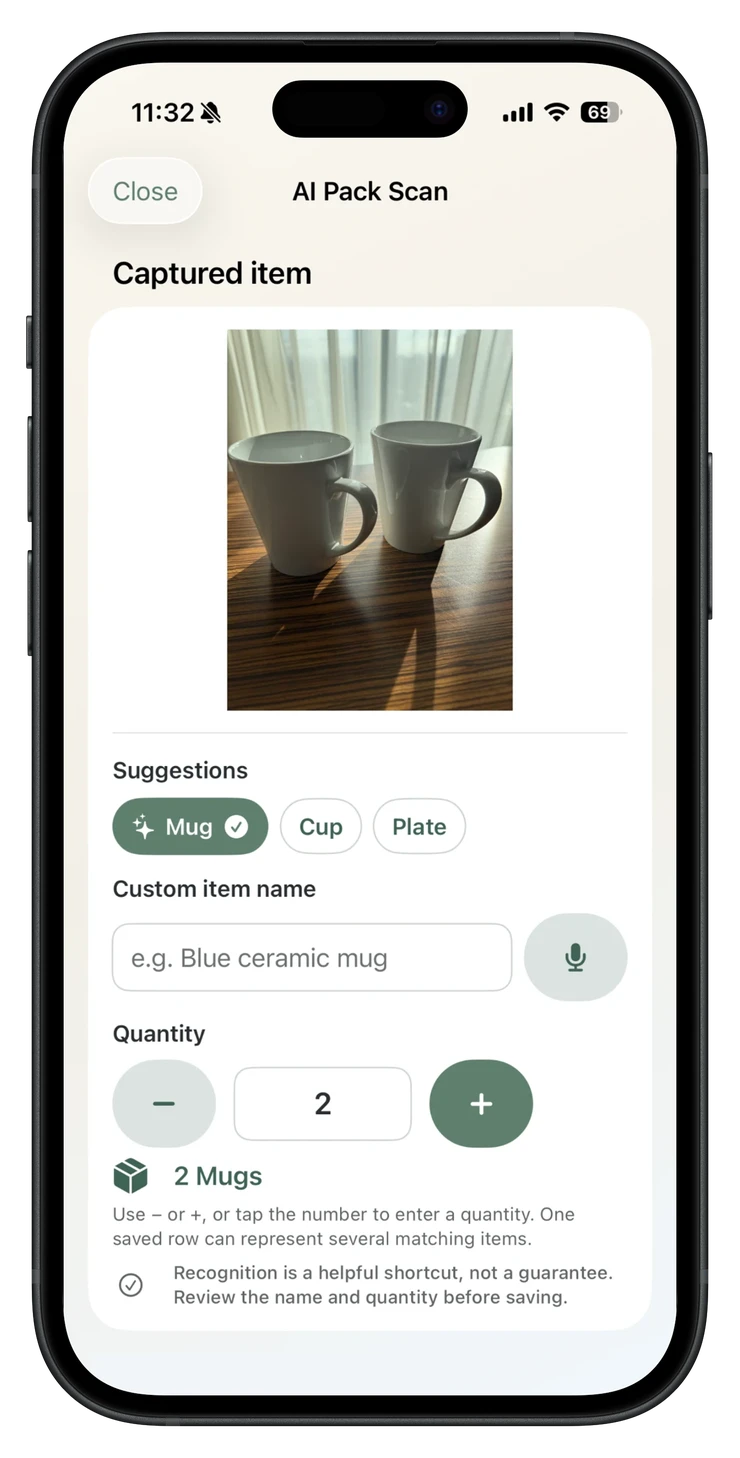
Version 1.3 adds an optional on-device recognition workflow that can suggest household-item names and quantities from photographs. Suggestions are intended to reduce typing, not replace the user’s judgement: PackQR will not recognise every object, and every name and quantity can be reviewed or changed before saving.
Success depends on the particular item and photograph. Ambient lighting, glare, shadows, camera angle, distance, background, obstruction and mixed groups can all change the result. A broad, incorrect or uncertain suggestion is an expected limitation rather than a promise of perfect recognition.
The core workflow uses Apple Vision on the iPhone or iPad. Item photographs are not sent to a hosted large-AI recognition model, an active internet connection is not required, and PackQR does not need an ongoing subscription to an external AI-model API.
Optional personalised learning can store compact visual examples from items the user deliberately corrects or teaches. Those examples stay on the device and remain linked to the source item and photograph. Similar suggestions may improve as packing continues, but learned results are still not guaranteed.
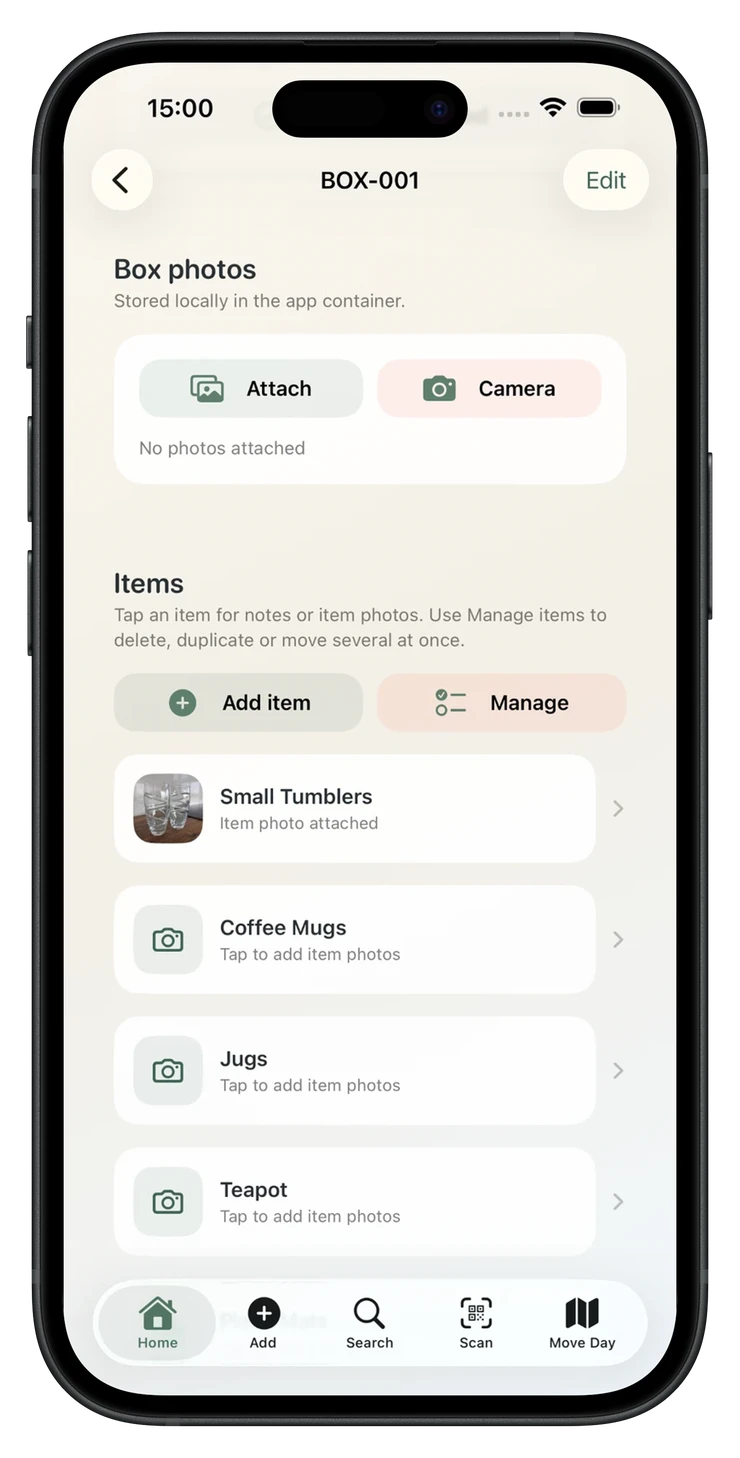
AI Pack Scan in three steps
23 July 2026
Move Planner 1.1 (Build 61) now released
Version 1.1 is now available free on the App Store for iPhone and iPad. The release improves Dark Mode readability across supporting text, placeholders, cards, dividers and task controls.
On iPad, the human-readable plan summary now opens in a modal system share sheet above the complete app interface. Existing links, widgets and the optional private PackQR connection remain compatible.
22 July 2026
Move Planner by PackQR now live
Move Planner by PackQR is now available free on the App Store for iPhone and iPad. It works as a complete standalone moving planner with no PackQR purchase, account, advertising or subscription required.
People who also use PackQR can optionally enable a private on-device connection. The apps exchange aggregate packing progress and validated workflow handoffs only; item names, notes, photographs, QR information, searches and backup contents are not shared.
16 July 2026
PackQR 1.2 now live
Version 1.2 is now available on the App Store. The release adds a complete appearance-aware Dark Mode with refined action hierarchy, readable sheets, fields and scanning controls.
QR-label output now supports A4 and US Letter in 1-up, 2-up, 4-up and four-copy layouts, plus native 4 × 6-inch output for compatible label printers. Private contents lists can be printed on A4 or US Letter. Labels continue to show box number, room and handling flags only—never item contents.
The release also improves contextual Move Planner installation detection and clarifies that private packing-summary sharing is optional, off by default and readable only on-device when the companion app is installed.
16 July 2026
PackQR 1.1 phased rollout
Version 1.1 added encrypted-backup improvements, Quick Photos, safer Unassigned Contents handling and an off-by-default private on-device summary for the separate Move Planner app.
Move Planner integration was included in preparation for the companion app’s App Store release.
Enabling sharing prepares an aggregate summary on the device. Item names, notes, photographs, QR information and backup contents are not shared, and nothing happens until Move Planner is installed.
14 July 2026
PackQR approved for App Store release
Apple completed review of PackQR: House Move Box Scanner. Version 1.0 is available for public distribution at £1.99 as a one-time purchase. The free Move Planner companion remains in pre-release and will be submitted separately after final device testing.
13 July 2026
Calm reminders, widgets and local app-to-app integration
The Move Planner Build 37 test branch now includes a single-actionable app badge, consolidated smart briefings, notification actions, Home Screen and Lock Screen widgets, a seven-day Coming Up sheet, app-icon quick actions and a user-started Move Day Live Activity. PackQR Build 79 adds an off-by-default local summary and versioned deep links for room, Open First, backup, Move Day scanning and unpacking workflows. The integration shares aggregate counts only and remains in development testing.
11 July 2026
Trust and transparency update
Added named authorship and publication dates across the Moving Library, plus About, Author, Editorial Policy and Terms pages. Expanded the website privacy information and added canonical redirects, structured data, a sitemap and crawler guidance.
10 July 2026
Free checklist collection expanded
Expanded the downloadable resource library to sixteen practical infographics covering planning, packing, moving day, student moves, family moves, storage, unpacking and new-home safety.
10 July 2026
Resource gallery improvements
Added consistent desktop card sizing, swipeable mobile galleries and an on-page lightbox so visitors can view full-resolution guides without leaving the Resources page.
6 July 2026
Local-first privacy documentation
Published the initial explanation of the intended local data model, manual backups, privacy-safe QR labels and account-free product design.
Current development focus
- Monitoring PackQR 1.9 release feedback across Siri/Shortcuts results, Spotlight discovery, Duo layout continuity, nearby collaboration, Sensitive Boxes, replacement-value reports and local-data recovery.
- Keeping normal packing fast: keyboard, voice, AI Pack Scan and Pack Batch remain value-optional and reviewable.
- Maintaining upgrade and backup safety so existing local inventories are preserved across normal App Store/TestFlight updates.
- Keeping Sensitive-box redaction, collaboration scope boundaries, backups, reports, labels, search, scanning and Dark Mode consistent across iPhone and iPad.
- Keeping future cloud accounts, automatic appraisal and external pricing lookup out of scope unless they can preserve PackQR’s simplicity and privacy model.